
There’s been a rush to use AI tools to work faster, draft quicker, design more, and edit at a pace we haven’t seen before. There are undeniable benefits here, and genuinely new opportunities that platforms and creative tools didn’t offer even a year or two ago. But alongside that rush, we’re now seeing a parallel rush toward transparency, in the form of watermarks and labels attached to that content, often automatically and without an opt-out.
There’s a catch, though. Even the smallest changes are being flagged, with no delineation between what’s been generated by AI from scratch and what’s simply been edited. If you’re tightening copy (which we’ll often do), stretching a background image in Canva, or making a minor creative adjustment, several platforms currently treat it the same as full AI generation once it’s flagged. Here’s what you need to know.
Consumers still don’t trust AI-generated content
It’s worth remembering the context here before anything else. Recent industry research found that 82% of advertising executives believe Gen Z and Millennial audiences feel positive about AI-generated ads, but only 45% of those audiences actually do, and that gap has widened since 2024. Gen Z in particular skews negative, describing brands that use AI in ads as inauthentic, disconnected or unethical at meaningfully higher rates than advertisers expect. Marketers are, broadly, more comfortable with AI-generated content than the people they’re making it for.
What the platforms are flagging
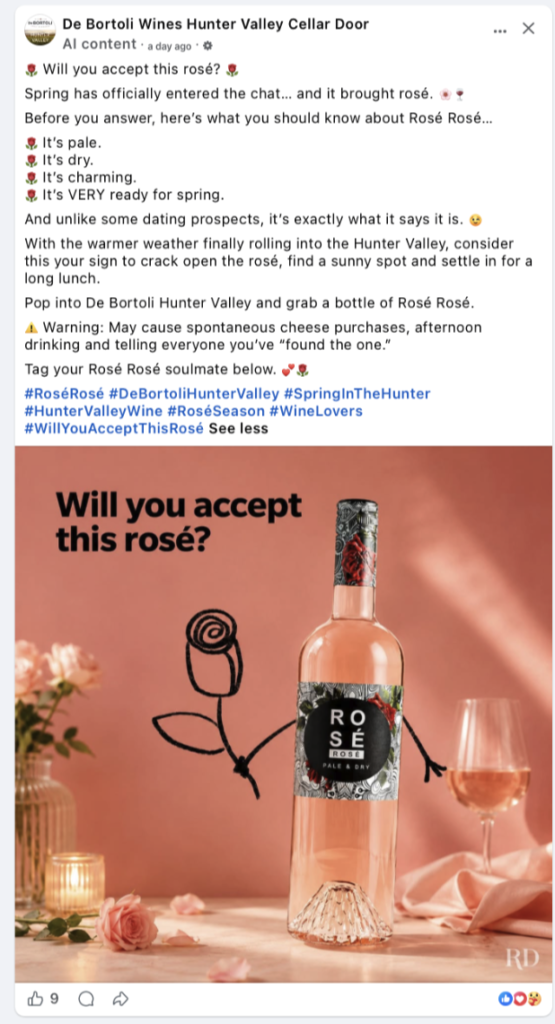
Meta runs the broadest AI labelling framework of any platform, applying labels across Facebook, Instagram, Threads and WhatsApp. It detects AI-generated content from outside tools too, not just its own AI features, including Midjourney, DALL-E, Adobe Firefly and Canva. You can see how this flag is applied on the De Bortoli Hunter Valley Cellar Door image below at the top left hand corner.
TikTok was the first major platform to integrate C2PA detection, back in January 2025, and now automatically identifies and labels AI-generated video using a mix of Content Credentials, invisible watermarking and its own detection models, reportedly across well over a billion videos already. Its 2026 policy requires a visible label on any content using AI to generate or meaningfully alter realistic people, places or events. AI-written captions, hashtags and scripts are exempt, it’s the visual and audio media itself that triggers the requirement, not the planning layer around it.
YouTube works differently again; it relies on creator self-disclosure rather than automatic detection. Since May 2025, creators have been required to declare in the upload process whether a video contains realistic altered or synthetic content, meaning content a viewer could easily mistake for a real person, place or event. YouTube tightened where that disclosure appears to viewers in May 2026, timed to the EU AI Act’s compliance deadline. Importantly, YouTube can still apply a label itself, even without creator disclosure, if it judges the content likely to confuse or mislead.
What the AI tools themselves are flagging
Claude: From August 2026, to comply with new European regulations on AI transparency, Anthropic began embedding an invisible watermark into all Claude-generated text, applied globally with no opt-out. A light grammar pass and a fully AI-drafted piece currently carry the same signal.
ChatGPT and DALL-E: OpenAI moved earlier than most, adding C2PA metadata to DALL-E 3 images back in 2024, alongside a small visible “CR” symbol in the corner of the image. Currently this only covers still images generated through ChatGPT or OpenAI’s API, not video or text.
Canva: Design tools aren’t exempt either. Cropping and straightening a photo, removing a blemish, or using the background remover can all now be flagged the same as fully AI-generated content, and that tag can travel with the file once it’s downloaded and used in ads or other creative.
Google: Google’s own watermarking system, SynthID, is arguably the most extensive of any single provider, covering text, images (Imagen), video (Veo) and audio (Lyria) across its Gemini products, with well over 20 billion pieces of content marked to date. Free and Pro-tier users also get a small visible “sparkle” watermark on generated images, which is removed for paying Ultra-tier subscribers, though the invisible SynthID mark stays regardless of tier.
The watermark itself, whichever tool applies it, is generally undetectable to the eye but identifiable with the right tool. It travels with content when copied, pasted or downloaded, and can survive light editing. It flags that AI touched the content somewhere in its history, not who wrote or made the underlying idea, or how much was changed afterward.
Generation and editing are currently being flagged the same way
There’s a meaningful difference between generative AI, where you prompt a tool and it creates something new from scratch, and AI-assisted editing, where something that already existed is simply being tweaked. As of September 2026, the detection and labelling systems in wide use don’t currently draw that distinction. Interestingly, the EU AI Act’s own regulation draws a narrower line than the platforms do, standard retouching like background removal or colour correction sits outside its marking requirement, it’s the platforms’ own broader detection net that catches it regardless of what the underlying law actually requires.
It’s also worth knowing that none of this is as reliable as it might sound, watermarks and metadata can be lost through routine editing, screenshotting or reformatting, sometimes without anyone intending to strip them. Independent researchers have already demonstrated ways to neutralise Google’s SynthID watermark, and a formal security analysis found the C2PA standard doesn’t yet meet its own stated security goals. AI detection is still in its infancy and evolving quickly. It’s not foolproof in either direction, but it is something worth being aware of.
What this means for Australian digital marketers specifically
Australia hasn’t introduced AI-specific advertising legislation, yet. Instead, the Australian Treasury’s October 2025 review concluded the existing Australian Consumer Law is already well-suited to cover AI-generated and AI-assisted content, meaning the prohibition on misleading or deceptive conduct applies regardless of what technology produced the content.
For anyone posting to global platforms from Australia, there are effectively two separate layers at play: the platform-level labelling described above, which applies globally and isn’t specific to Australia, and the local legal backdrop.
Does this actually matter?
For the platforms, compliance carries real weight. The EU rules that have come into effect mean global platforms now have to think seriously about transparency, and that pressure flows through to how they treat content everywhere, not just in Europe. It’s not yet clear how Australian regulators will respond, but the pace here is moving quickly.
For consumers, it’s more complicated. Much likely it will depend on the specific image or piece of text. Some audiences will be able to tell the difference between something authentic-but-tweaked and something generated outright, and some creators may simply move tools, back toward established software like Photoshop or Grammarly, for edits that would otherwise get flagged, since many of these adjustments were already available well before AI watermarking existed.
Worth knowing too: none of this currently applies retrospectively. Existing content doesn’t get flagged after the fact, only what’s created or edited going forward.
What Mastermind uses AI for in our own creative work
We’ll continue using these AI tools across client work, where they genuinely enhance the output. Our creative team brings real craft to the words, direction and content we produce, and that’s a different exercise to asking a generative tool to create something from scratch. We think most consumers are perfectly capable of making that same distinction. So for now, it’s a space we’re watching closely, valuing still the value in great creative which continues to be more important than ever.


